
Dunkirk: Review and Analysis
Review summary
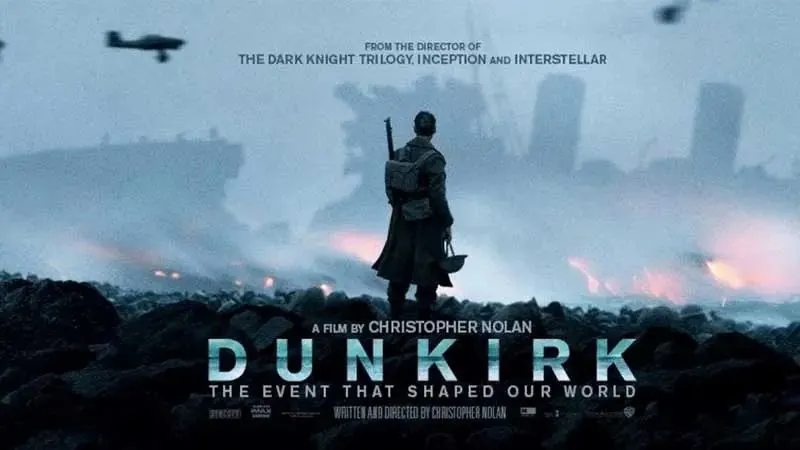
In Dunkirk, Christopher Nolan tells the story of war not through a hero but as a sensory experience of survival. It is a well-made, precise film, and its clever time structure is its greatest strength.
In Dunkirk, Christopher Nolan decides to tell the story of war neither through a hero, nor through a classic plot, nor even through a single main character. He wants to convey the experience of war and survival itself.
That decision is the film’s greatest strength, and it is also the main reason I stop short of a higher rating.
Dunkirk is a very well-made, precise and technically impressive film, but it offers an experience different from many of Nolan’s other works. There is no narrative complexity like Inception, no mind game like Memento, no emotional depth like Interstellar. Here Nolan mostly sets out to build a sensory, physical experience, and in that respect the film truly succeeds.
War seen through survival
At the centre of Dunkirk is the evacuation of Allied forces from Dunkirk during the Second World War. But Nolan has no interest in telling this event like an ordinary war movie.
Instead of explaining who the hero is, who the enemy is and exactly what is going on, he puts the audience directly in the middle of the situation. Like the soldiers in the film, we don’t have complete information: we don’t know exactly when the enemy planes will arrive, we don’t know whether the next boat will show up, and we don’t know whether the soldiers will manage to escape.
This limit on information creates a large part of the film’s suspense. In effect, Nolan tries to make the audience feel war rather than watch it.
Time as the main character
One of the most important features of Dunkirk is its time structure. Nolan follows the story in three strands: one week on the beach, one day at sea, and one hour in the air. These three narratives don’t run on the same clock, but in the end they meet.
In most films, time is simply what the story happens inside. In Dunkirk, time itself is part of the story. As the film moves forward, the strands draw closer together, and events that first seemed independent take on a new meaning.
But is that structure enough?
This is where my rating moves away from a 9 or a 10. I admire the structure, but for me an outstanding structure alone is not enough. The film is technically very powerful, but its characterisation isn’t as deep as in many other Nolan films.
We see people struggling to stay alive, but we get little chance to know them. That choice is partly deliberate; Nolan doesn’t want to turn the film into a character-driven drama. But the result is that my emotional distance from the characters is greater than in films like Interstellar or The Prestige. In those films, events matter to me because the characters matter to me; in Dunkirk, it is mostly the situation itself that matters. And that is an important difference.
Suspense without the need for explanation
One of the film’s most successful elements is its use of suspense. To create fear and anxiety, Nolan doesn’t always need dialogue; sometimes the sound of an engine is enough, sometimes a distant aircraft, sometimes silence, and sometimes just waiting.
In many scenes we know something bad is probably coming, but we don’t know when. That waiting creates psychological pressure. This kind of suspense appeals to me because, instead of telling us in dialogue that “this situation is dangerous,” Nolan lets us feel the danger ourselves.
Sound and music: the beating heart of the film
If I had to pick one of Dunkirk’s greatest strengths, it would probably be its sound and music. Hans Zimmer’s score and the film’s sound design keep a sense of anxiety alive almost constantly. The engines of the aircraft, the gunfire, the waves and the ambient noise are all part of the narrative.
In this film, sound is not a side element; it becomes a storytelling tool. In some moments, we learn through sound that something is happening before we see anything. That is what turns the film from a purely visual experience into a sensory one.
Cinematography and cinematic scale
The cinematography of Dunkirk is another of its standout qualities. Nolan has tried to show war as real and physical as possible. The use of large formats, real locations and restrained visual effects means many scenes never feel like an artificial reconstruction.
As a result, the sea feels truly vast, the sky truly threatening, and the beach truly like a place where thousands of people are trapped. This is what Nolan’s cinema does at its best: it doesn’t just show scale, it conveys it to the audience.
There is no hero
One of the interesting decisions in the film is that you can hardly define a classic hero for it. Here the ordinary soldier, the pilot, the sailor and the civilian are all part of a larger situation. Nolan deliberately sets heroism aside, and that makes the film more about the group than about an individual. Even the title points to this: it is not the story of one person; it is the story of thousands of people caught in a historic situation who are simply trying to stay alive.
Why 8 out of 10?
I don’t consider Dunkirk a weak film; on the contrary, in direction, cinematography, editing, sound and the design of suspense, it is one of Nolan’s most powerful works. But at one point the film moves away from what I expect from Nolan’s cinema; I prefer films that have, in addition to structure and technical execution, a story and characters I can connect with emotionally.
Dunkirk is more an experience than a character-driven story, and it is a very well-made experience; but for me it is not as complete in storytelling and emotional connection as Inception, Interstellar or The Prestige.
Still, the film’s main achievement can’t be overlooked. Nolan has managed to tell one of the most famous events of the Second World War without turning it into a clichéd war movie. Instead of making heroes, he focuses on survival, and instead of explaining the war, he tries to place the audience inside it. That is why I see Dunkirk as a film that may not engage me as much as some of Nolan’s other works in terms of story, but is thoroughly respectable, and even admirable, as filmmaking.
To work with me on projects like these, click this button.
My services & collaboration