
Interstellar: Review and Analysis
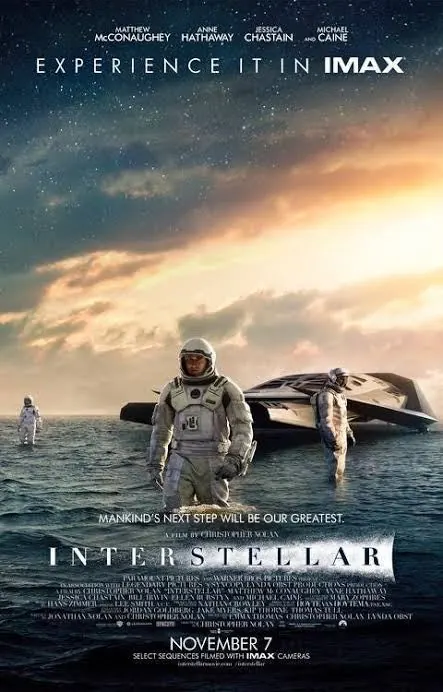
Review summary
For me, Interstellar lifts science fiction beyond a merely entertaining genre. By combining cosmic grandeur with a deeply human story of love, separation and sacrifice, Nolan makes a film that engages both mind and heart.
Interstellar is one of those films that, for me, lifts the definition of “science fiction” beyond a merely entertaining genre. In it, Christopher Nolan goes into space, time, relativity, black holes and the future of humankind, but in the end what makes the film last is not its cosmic grandeur but a deeply human story about love, separation and sacrifice.
This is the point where Interstellar becomes a 10 out of 10 for me. Nolan made a film that wants, on the one hand, to talk about the survival of humanity and the future of the planet, and on the other, to tell the story of a father who has to leave his children so that a future might remain for them. That tension is the heart of the film.
When Earth is no longer a safe home
The film begins in a future where Earth is no longer fit for human life. Agriculture is dying, and humanity faces a simple but frightening question: if Earth can no longer be lived on, what do we do?
Instead of looking for the answer on Earth, Nolan turns his camera to the sky. What makes the story compelling, though, is that the space journey is never a heroic adventure from the start; Cooper knows he may never see his children again. So his mission is tied to personal sacrifice from the very beginning.
Cooper and Murph
For me, the most important relationship in the film is the one between Cooper and his daughter Murph. Without it, all the scientific ideas in the film could have become an extremely expensive and impressive spectacle that isn’t necessarily emotional.
Murph is angry at her father because she feels he abandoned her. Cooper, for his part, has no easy choice; to save his children’s future he has to go far away from them. That contradiction is one of the most painful parts of the film: sometimes, to protect someone, you have to do something that looks like betrayal in that person’s eyes.
Nolan makes this relationship one of the story’s main pillars, and as a result, when the concept of time enters the story later in the film, its emotional impact multiplies.
Time, the film’s greatest enemy
One of Nolan’s smartest decisions is to turn time into a dramatic element. In many science-fiction films, time is a scientific concept; in Interstellar, time becomes a source of pain and tragedy.
Approaching a black hole means the time that passes for Cooper is not the same as the time passing for his daughter on Earth. Cooper watches messages from years past and sees that his daughter has grown up while he was in space; for Cooper only a few hours or years have passed, but for Murph a whole lifetime is going by.
This is no longer just relativity; here relativity has become feeling. Nolan has managed to turn a scientific concept into something the audience can understand with the heart.
The black hole and visual grandeur
Visually, Interstellar is one of Nolan’s most striking works. The black hole, Gargantua, is not merely a special effect; the way it is shown is the product of science, careful calculation and visual design.
But the value of the film’s images isn’t only in their beauty. Unknown planets, boundless space, the silence of space and the grandeur of the black hole all create one shared feeling: how small human beings are before the universe. Cooper and the crew aren’t in a familiar environment; they stand before something whose scale is far beyond ordinary human understanding.
Space travel without the usual heroics
One of the things I love about Interstellar is that space travel is not just a display of human power. Every wrong decision has a cost, every minute matters, every planet can be a disaster, and every choice may come at the price of years of life for the people on Earth.
As a result, the film’s suspense doesn’t come only from physical danger; the real danger is time. The farther Cooper goes, the greater his distance from home, and at the same time time passes faster for the people he loves.
Hans Zimmer’s music
You can’t talk about Interstellar and pass over Hans Zimmer’s music. In this film the music is almost a character in its own right; in many scenes, instead of merely accompanying the emotion, it creates it. Especially in moments when the vastness of space meets the loneliness of the characters, the music multiplies the impact of the images.
Can love really cross time?
One of the most debated parts of the film is the idea of love as something that can act beyond time and space. Scientifically, this part can’t be taken as a real physical theory; but the film doesn’t necessarily want to replace science with love.
For me, love in Interstellar is more of a human concept. In the end, all the calculations, technologies and scientific theories are only tools. What brings Cooper back toward home isn’t a formula; he wants to reach his daughter. And that is where the film turns once more from a huge science-fiction story into a human one.
Why did I give Interstellar a 10?
For me, Interstellar has almost everything I expect from a great film: a big idea, powerful storytelling, characterisation, superb cinematography, unforgettable music, visual effects, suspense and, most of all, a real emotional core.
The film appeals both to viewers who love science and space and to someone with no particular interest in physics; that matters a great deal to me. Nolan doesn’t have to turn the audience into experts on relativity in order to involve them with the concept of time. He turns an extremely complex scientific idea into an experience almost anyone can understand: the fear of losing the people we love and the longing for years that will never come back.
That is why Interstellar is, for me, not just an extraordinary science-fiction film; it is a film about time, family, love, sacrifice and humanity’s hope of carrying on. And perhaps that is the most important reason for my 10: a film that can engage mind and heart this much, at the same time, is rarely made.
To work with me on projects like these, click this button.
My services & collaboration