
The Odyssey: Nolan at the Height of Storytelling (Review, 10/10)
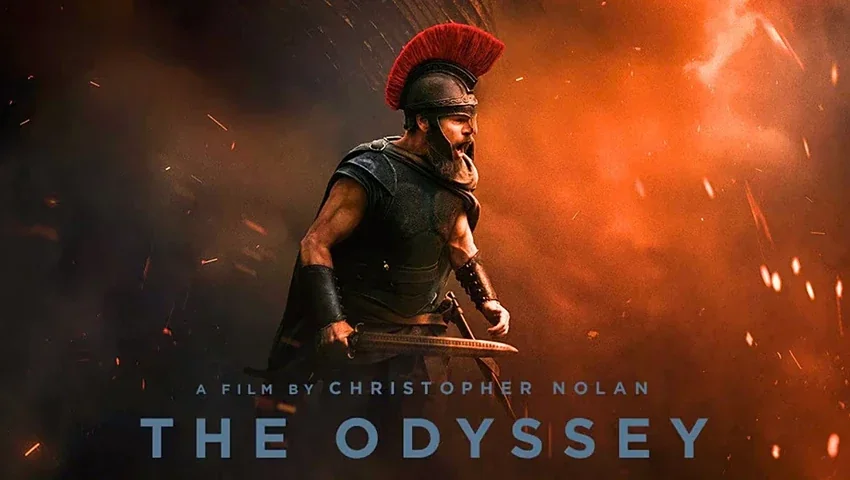
Review summary
A review of Christopher Nolan’s “The Odyssey” (2026), starring Matt Damon: a film that never trades storytelling for spectacle, with a coherent rhythm and an adaptation faithful to the spirit of Homer.
When “The Odyssey” ended I was thinking less about any single scene and more about the whole: how it keeps a mythic journey on its feet for nearly three hours with almost no sag. For me this film is a 10 out of 10, and below I explain why.
Christopher Nolan went to one of the best-known stories in world literature, a tale of travel, return, loss and loyalty that has been retold for centuries. That is an ambitious choice, and the risk is clear: falling into the trap of simply retelling a classic text. Nolan does not fall into it. He rebuilds Odysseus’s journey in the language of cinema rather than giving us a visual translation of a book.
The storytelling: the film’s greatest strength
To me the greatest asset of “The Odyssey” is its screenplay and the way events are arranged. Every encounter and every change of situation is part of a defined path and prepares the viewer for the next stretch. This is not a string of adventures laid end to end.
It is what I see too rarely in expensive films today: plenty of characters, events and effects, but no firm link between them. In “The Odyssey” I never felt a scene was there only to fill time or manufacture excitement.
Controlling information is one of the hardest skills a filmmaker has. Say it too early and the suspense dies; too late and the story turns vague and tiring; explain everything and there is no room for the viewer’s own mind. Nolan keeps this balance well: we know enough to follow the road and not enough to stop being curious.
Pacing: long, but never wasted
A long running time is not a flaw in itself; the question is what the film does with its time. My test is simple: if this scene were removed, would something be lost from the story, a character or the atmosphere? For “The Odyssey” my answer is almost always yes.
The film knows when to speed up and when to pause, and its pauses are never without reason. Epic stories tend to risk scattering; Nolan holds the sprawl inside a coherent structure, and the result is a film with both breadth and focus.
Matt Damon: carrying the story on his shoulders
Matt Damon’s performance as Odysseus is one of the main reasons the film lands emotionally. A character at the centre of a story like this must bear a great deal of narrative weight, and Damon does it without showing off, keeping the character believably alive inside the story.
Odysseus is not just an invincible hero. His appeal lies in the hard road, the choices and the trials he goes through, and Damon conveys these layers without exaggeration. His presence gives the film stability and keeps us with the central character to the end.
The cast around him, from Tom Holland and Anne Hathaway to Robert Pattinson, Lupita Nyong’o, Zendaya and Charlize Theron, all contribute to building the film’s world, and their coordination keeps it unified in performance.
Direction, image and world-building
Nolan does not let outward grandeur take the place of storytelling. The film’s large scale is part of the story’s world, not an end in itself. The links between the different stages of the journey are strong enough that the film never breaks into separate episodes; it has a single identity.
His collaboration with cinematographer Hoyte van Hoytema, this time shooting the whole film on IMAX film, produces imagery that serves the storytelling. Composition, choice of angles and the relationship between characters and their surroundings all help build the world. For me the value of cinematography shows when I can take information and feeling from the frame, the space and the camera movement even without dialogue; “The Odyssey” does that.
Production design, costume, lighting and mise-en-scène create a world with its own rules and identity, nothing like sets built for a handful of scenes. Space is not just a backdrop; it shapes how we understand the characters’ situation. In a story where the journey is the core, geography is part of the characters’ experience, and the film conveys both the breadth of that journey and its human side.
The adaptation: faithful to the spirit of the story
Being faithful to a literary work does not mean carrying over every detail. Literature and cinema are different languages, and what a text does through description and a character’s inner life must be recreated in film through image, sound, performance, editing and structure. A good adaptation understands the spirit of the work and finds a cinematic language for it.
The ideas of “The Odyssey” (travel, homecoming, facing the unknown, one trial after another) are not tied to a single historical era, and they are familiar to today’s audience because they concern human experience: someone who chooses, pays a price and changes along the way to a goal. The film turns that capacity into an independent cinematic experience; you do not need to have read Homer to enjoy it.
Music, editing and how the parts fit
A successful film is rarely the product of one outstanding element. Jennifer Lame’s editing keeps the story flowing, Ludwig Göransson’s music serves the atmosphere, and the sound design helps make the world believable. Editing that is too fast takes away time to take things in, and editing that is too slow drains the energy; music that steers the emotions constantly weakens the scenes.
In “The Odyssey” none of these elements shows off, and all of them work towards one experience. That harmony may be less noticeable than a brilliant performance or a huge set piece, but it is what makes the film a complete work.
Why 10 out of 10?
A perfect score, for me, does not just mean I enjoyed it; it means I found no serious, decisive flaw in the most important things I expect from a film. “The Odyssey” is like that: a powerful screenplay, controlled storytelling, momentum that holds over a long running time, actors who give the world life, and a high standard of image and execution.
More important, these qualities do not work separately. While watching I thought less about which part was better than the rest and more about being inside one unified experience. To me that is the difference between a good film, a very good film and a masterpiece: a masterpiece is not a collection of strengths but strengths turned into a meaningful whole.
Conclusion
“The Odyssey” is a reminder that great cinema is not necessarily expensive cinema or one full of huge set pieces. It takes shape when a filmmaker knows what story he is telling, why every scene must exist, and how to use all of cinema’s tools to deliver his experience. Building on a classic story, Nolan made a work that for me stands at the highest level in storytelling, acting, direction and visual quality.
Despite its length, I never felt the film was wasting my time, and for me that alone matters a great deal. “The Odyssey” is one of the most complete cinematic experiences of recent years. Final score: 10 out of 10.
Film details
Christopher Nolan; adapted from Homer’s Odyssey
Matt Damon (Odysseus), Tom Holland, Anne Hathaway, Robert Pattinson, Lupita Nyong’o, Zendaya and Charlize Theron
Hoyte van Hoytema
Ludwig Göransson
Jennifer Lame
July 17, 2026; about 172 minutes
To work with me on projects like these, click this button.
My services & collaboration