
When Does a Company Need an IT Director?
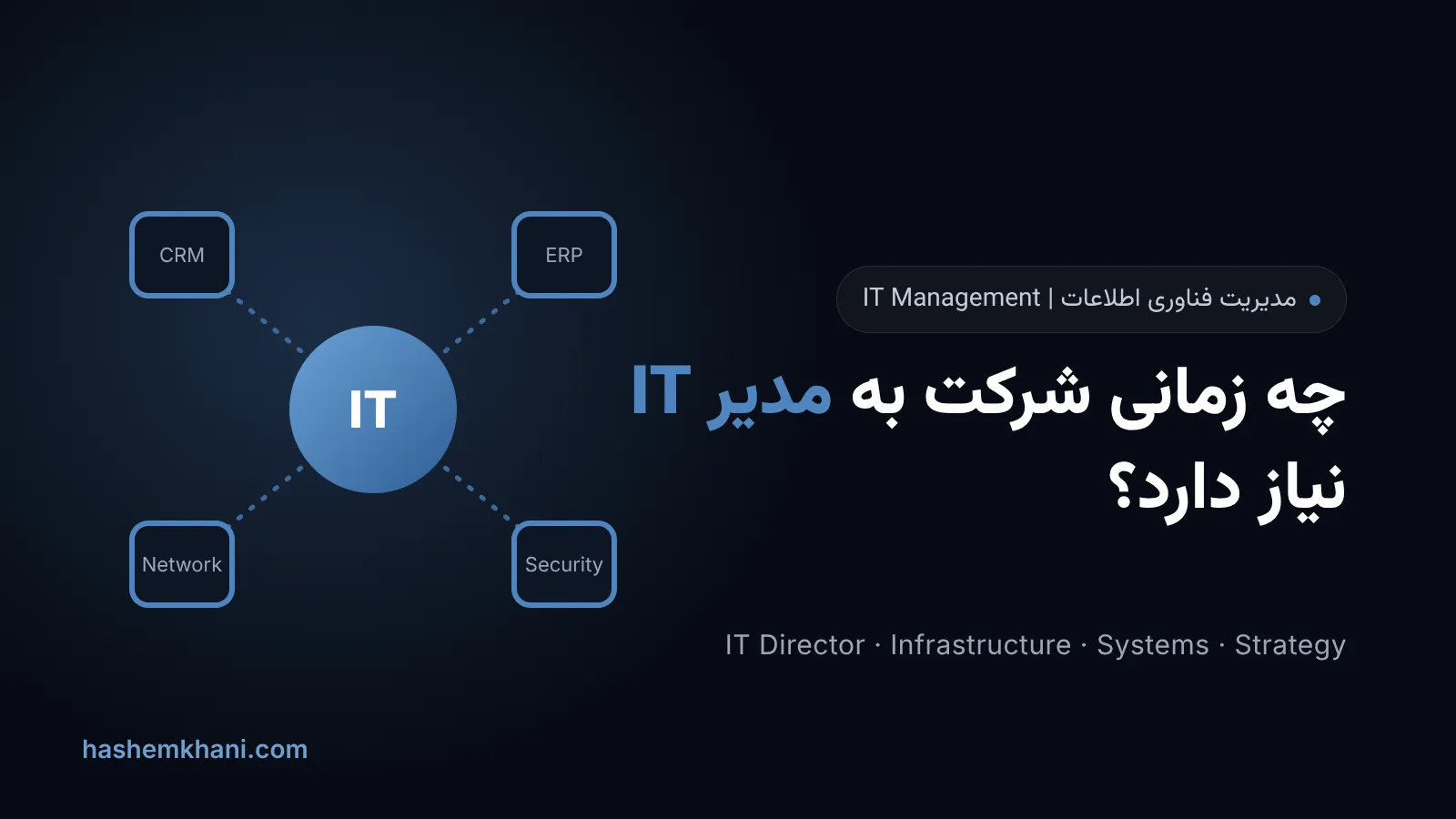
While a company is small, IT management may be limited to installing a few programs, looking after computers and handling everyday problems. As the organisation grows, technology becomes an important part of operations, sales, customer relations and management decisions. At that point a support person is no longer enough; the company needs a manager who can steer all of its technology towards the goals of the business.
Summary
An IT director is not only responsible for equipment and fixing technical problems. They link technology, the organisation’s processes and its business goals. If the company’s systems are scattered, information does not flow properly, software projects run without management, or technology infrastructure has not kept up with the organisation’s growth, it is probably time to manage information technology in a professional, structured way.
What exactly does an IT director do?
An IT director (or IT manager) is responsible for planning, organising and managing technology resources and solutions in an organisation. Their main job is not to solve every technical problem personally; it is to make sure the technology the company uses meets today’s needs and is ready for future growth.
Suppose a company has sales, finance, warehouse and support units. Each unit uses different software, customer information is recorded in several places, and for an accurate report the CEO has to collect data from several people. This is not just a software problem; it is a sign that nobody takes a unified view of the organisation’s technology and processes.
An IT director must spot problems like these, set priorities, and propose a solution that fits the company’s structure and budget.
7 signs your company needs an IT director
1. Technology has grown without a plan, piece by piece
Many companies, early on, buy the equipment and software they need gradually, driven by urgent needs. That is natural at first; but if the same approach continues through all the years of growth, the infrastructure becomes a collection of unrelated tools.
Servers, network, finance software, the sales system and communication tools may all have grown without a defined architecture. In that situation, changing or extending one part can affect the others.
The IT director’s role
Reviewing the current state, finding weaknesses in the infrastructure, setting priorities and drawing up a roadmap for coordinated development of information technology.
2. The organisation’s information is scattered across systems
One common problem in growing companies is that information does not flow in one place. Customer data sits in the CRM, financial data in the accounting software, stock in the warehouse system and sales reports in separate files.
If these systems do not connect well, duplicate or contradictory information appears and management reports become hard to produce.
An IT director needs to work out which systems should connect, what data should be recorded where, and how to avoid rework and errors. Sometimes the answer is connecting the existing software; sometimes a new system must be chosen or designed.
3. Software projects run without clear management
Buying or developing software does not by itself guarantee a project will succeed. If the organisation’s needs have not been properly defined, if the contractor has understood the client differently, or if there is no clear criterion for delivery, the result may be far from what the organisation expected.
In that situation the IT director should supervise the project on the organisation’s behalf: from understanding the need and reviewing solutions to assessing the contractor, managing delivery, testing and final handover.
4. The company depends on outside people or firms for every small change
Using specialist contractors is sensible on many projects; but when nobody inside the organisation is responsible for understanding the systems, documenting them, assessing proposals and supervising the contractor’s work, dependence on outsiders becomes excessive.
An IT director does not have to do everything personally. They should be able to translate the organisation’s need into technical and operational terms, assess technical proposals and make sure the contractor’s output matches the company’s real need.
5. Infrastructure has not kept pace with the company’s growth
More staff, branches, users, customers and operations change an organisation’s technology needs. Infrastructure that suited a small company may not cope with an organisation doing far more.
Network and server capacity, information security, user access, backup, branch connectivity and the ability to extend systems all need to be checked against the company’s growth plan.
6. Managers cannot get accurate, timely information for decisions
When information lives in different software and files, managers may not have an accurate picture of sales, stock, unit performance or customers.
This is not solved just by buying reporting software. First you need to define what information decisions require, where the data comes from, and how its accuracy and integrity will be maintained.
7. IT has become a barrier to growth rather than supporting it
If every new development brings technical problems, rework, unexpected costs or disruption to existing systems, the organisation’s technology has probably fallen behind the growth of the business.
Instead of reacting constantly to daily problems, an IT director should plan for the future and make sure today’s choices do not impose serious limits on tomorrow’s organisation.
How is an IT director different from network and computer support staff?
The two roles are related, but their responsibility and level of decision-making differ. Technical support staff usually focus on the day-to-day running of equipment, network and systems, and on fixing users’ problems. An IT director, besides understanding these areas, is responsible for planning and managing the organisation’s technology at a higher level.
IT support staff
Fixing users’ problems, maintaining equipment, looking after the network and following up everyday technical issues.
IT director
Setting technology strategy, managing infrastructure and systems, choosing solutions, managing the team and contractors, and aligning technology with business goals.
An organisation may need both roles. An IT director can lead an in-house team or contractors, but should not be seen as a replacement for all the operational and specialist staff.
Does every company need a full-time IT director?
No. Needing IT management does not necessarily mean hiring a full-time director. The form of the engagement should match the size of the organisation, the complexity of its systems, the number of users, the sensitivity of its information and the volume of technology projects.
For some companies a full-time IT director makes sense. In others, a part-time or project-based IT consultant or director can meet the need.
The important point is that responsibility for managing technology should not be split among several people without one named person accountable for the decisions and the direction of development.
What areas does an IT director manage in a business?
The scope of an IT director’s responsibility varies with each organisation’s structure, but it usually covers several main areas:
- Infrastructure and network: designing and managing infrastructure, servers, the network and user access.
- Enterprise systems: reviewing, choosing and deploying CRM, finance and operations software.
- Project management: planning and supervising software projects from analysis to delivery.
- Team and contractors: coordinating technical staff, assessing contractors and managing the working relationships.
- Security and continuity: protecting information, backup and keeping systems running.
- Technology planning: drawing up a roadmap and prioritising technology investments.
- Alignment with the business: turning the needs of different units into workable solutions.
Practical experience: building IT infrastructure from scratch at Damavand Product Development
One of my relevant experiences in IT management is at Damavand Product Development, where my responsibilities and work included building the company’s IT infrastructure from scratch, launching its CRM and finance systems, and managing informatics and the development path of its infrastructure.
On a project like this, the job is not just procuring equipment or installing software. You first have to understand the organisation’s real needs, look at how units and work processes relate, and then choose infrastructure and systems that can support the company’s operations.
Experience of this kind shows that IT infrastructure has to be designed to fit how the organisation operates. There is no single version for every company; a solution that suits a trading group may be the wrong choice for a manufacturer or a service company.
Key point
IT management creates real value when technical decisions start from operational needs and business goals, not from a list of equipment and software that simply happens to be on the market.
How do you know whether to hire an IT director or a consultant?
To choose the right engagement model, start by assessing the organisation’s situation:
- If the company faces many infrastructure and technical issues every day and has an in-house technology team, a full-time IT director can be a good choice.
- If the main issue is drawing up a roadmap, choosing a system, assessing a contractor or managing one specific project, a consulting or project-based engagement may be enough.
- If the company is starting up and has no defined infrastructure or enterprise systems yet, technology design and launch can be managed in stages.
- If the organisation has a technical team but needs someone to lead, prioritise and supervise projects, an agreed IT management model may suit.
What does working with an IT director look like?
An effective engagement should begin with understanding the current state and defining responsibilities precisely. A logical path might include these stages:
Understanding the need and the current state
Reviewing the organisation’s structure, processes, software, infrastructure and main technology issues.
Analysis and feasibility
Identifying workable solutions, constraints, technical needs and the organisation’s priorities.
Defining the solution and roadmap
Setting the projects, expected outputs, stages of delivery and responsibilities.
Managing delivery and deployment
Coordinating the in-house team and contractors, managing the project and following progress.
Testing, handover and review
Checking outputs against agreed criteria and preparing the system for operation.
Frequently asked questions about the IT director
What does an IT director do?
An IT director is responsible for planning and managing infrastructure, software systems, the technical team, contractors and technology projects, and for making sure technology fits the goals and needs of the business.
What is the difference between an IT manager and an IT director?
The titles can carry different scope in different companies. An IT director usually focuses more on strategy, policy and overall technology management, while an IT manager may carry more executive and operational responsibility. The job title alone is not decisive; look at the description of responsibilities.
Does an IT director have to be a programmer?
Not necessarily. Understanding software architecture, the development process and technical concepts matters, but the main job is managing technology and directing resources and projects. They must communicate well with technical specialists and judge technical decisions from the organisation’s point of view.
Does a small company need an IT director?
A small company may not need a full-time director, but if its work depends on software systems, customer data or digital infrastructure, it matters to have one named person responsible for managing technology.
Can an IT director also manage a software project?
Yes, if their experience and scope of responsibility fit the project’s needs. That can include analysing the need, choosing the contractor, managing delivery, testing and handover.
How is the cost of working with an IT director set?
It depends on the type of engagement, the size of the organisation, the complexity of the infrastructure, the number of projects, the length of the engagement and the level of responsibility. First the organisation’s situation and needs are reviewed, so a suitable model and estimate can be given.
Is your company’s technology ready for the next stage of growth?
If your company’s IT infrastructure needs a rethink, your enterprise systems do not connect properly, or you have a software project ahead, we can start by reviewing the current situation and the organisation’s real need.
I am Saeed Hashemkhani. With more than 25 years of experience in IT, software, e-commerce and project management, I work alongside organisations on infrastructure design, systems analysis and managing technology projects.
IT director services
A review of the current state and the organisation’s real need, from infrastructure and systems to managing technology projects.
View IT director services ↗To work with me on projects like these, click this button.
My services & collaboration